 |
|
|
 |
|
|
|
|
|
|
The following are past calls of the Clinton Fire Department. This is exactly how it was hand written in the department log books that are part of the history of CFD. Date, type of call, how long CFD was on the scene, and the fireman who responded to the call.
1-17-1966 - House Fire, Jim Draper House 4 hrs., Jedele, LaSavage, Smith, Winder, McDermont, Ruhl, Rider, Schuler, Olson, Hawkins, Reiser, Woodard, Hunt Zick, Flagman
___________
3-2-1966 - Grass Fire, Jim Renolds Home, Jedele, Schuler, Flagman
___________
3-16-1966 - Grass Fire, Dearborn Steel Plant #2, 2 acres, Jedele, Winder, B. Winder, McDermont, Herman, Ruhl, Schuler, Hunt, Zick, Flagman
|
11-2-1909
House Fire
Fire was discovered about 8 o'clock Saturday morning at he residence of David Lancaster on Brown street and some lively work done in putting it out.
The fire started in the woodshed located a few feet south of the kitchen. Mr. Lancaster was awakened by the barking of his dog who was kept in the woodshed, and when he opened the door the flames rushed out driving him back and making it impossible to get the animal out so she was burned to death.
Mr. Lancaster gave the alarm and L. V. Bauer was about the first man to respond. The fire hose was laid as quicklly as possible and two streams were soon playing upon the fire and in a very short time it was extinguished. The woodshed was destroyed and the southeast corner of the kitchen was considerably damaged on the outside.
The household goods were all removed from the building but the interior was considerably damaged by water and smoke. The things were put back in a few hours and the family were able to remain in their home.
Immediately after puchasing the property Mr. Lancaster took out an insurance policy so the loss is covered.
It has been impossible to be certain the cause of the fire as there had been no fire in the house, their kitchen stove not being set up yet.
The worth of our water pipe on Chicago street was again demonstrated, as without its use there is no telling how much damage might have been done to adjoining property.
CL
|
 |
7-28-1927
The members of the local fire department, accompanied by Frank Schuler of the village council, were in Adrian Thursday evening, where Fire Chief Whitney gave them some valuable instructions in the use of fire equipment and especially chemicals.
CL
|
12 - 01 - 1921
NEW FIRE SIGNALS ARE
ADOPTED BY VILLAGE
______
At Meeting of Fire Department
Held Monday Evening - Other
Details Attended To.
________
At a meeting held Monday night by the members of the newly appointed fire department, the village was divided into four districts and signals for each district decided upon. This will enable not only the fireman but all who take the time to memorize the signals to know in what part of town a fire happens to be in.
Following are the districts, with the signal for each:
No. 1 - That part of the village lying north of Chicago street and west of Jackson Street; signal, one long and one short blast of the fire whistle.
No. 2 - North of Chicago and east of Jackson; one long and two short blasts.
No. 3 - South of Chicago street and east of Tecumseh street; one long and three short blasts.
No. 4 - South of Chicago and west of Tecumseh; one long and four short blasts.
The various members of the department were assigned to specific duties in case of fire and other details attended to in order to make the organization efficent.
_________________
|
|
 |
|
| |
|
| |
|
| |
|
| |
|
| |
|
| |
|
| |
|
|
In the early years of Clinton's history, its fires were fought by a small group of volunteers. Lawson Ward, who was one of those hardy fire fighters stated in an interview in a History of Clinton Historical Book back in 1979. Lawson Ward described their equipment and stated that first came a four - wheel hand - pulled wagon that had a "V" frame built on it to hold the ladders. The space under the frame was used to carry buckets, pick axes, shovels, extra ropes, etc. In place of the teamster seat, a drum - like contraption with a ratchet that was installed and the pulling rope wrapped around it. When the fire bell rang, the men raced to a barn located near the old railroad station, unwound the rope and then raced to the fire, pulling the fire wagon by hand. At the scene of the fire, one man pumped the water from the well and "bucket brigade" was formed. Later on, when regulation fire hose was made, it was pulled to the fire on a two - wheeled cart.
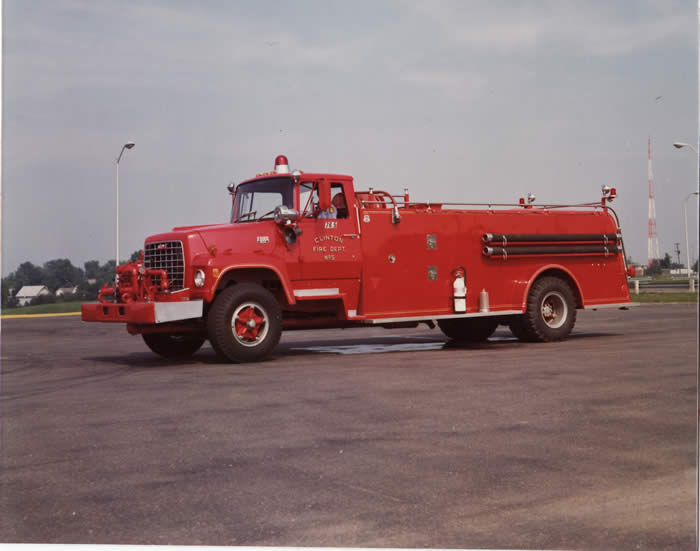
In 1926, the village council authorized the purchase of a Reo "Speedwagon" which was equipped with ladders, extinquishers, etc. In 1928, the equipment was moved from the Village barn to the original fire house. In 1938 the firemen raised money to buy their first pumper and the village put a 400 gallon water tank on it. In 1946 a new pumper was purchased and in 1952 a tank truck was added to the fleet.
The new fire house was built in 1969 and now houses modern and efficient fire-fighting and life-saving trucks including our most recently purchased 2004 Pierce Enforcer combination Rescue / Engine.
|
| |
|
|
| |
|
|
| |
|
|
|
|
|
|
|
|

